



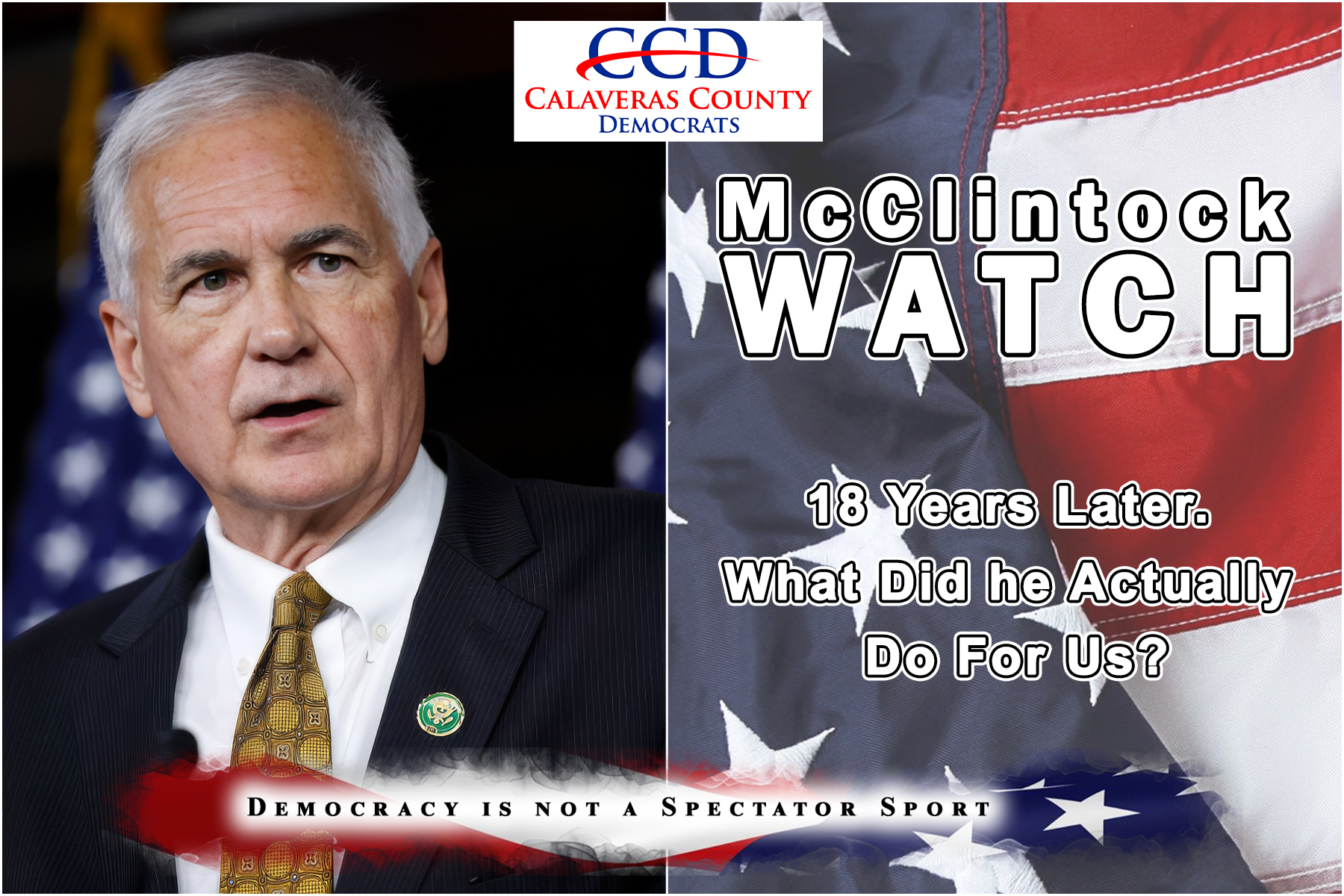
Tom McClintock: 18 Years Later, What Did He Actually Do for Us?
Tom McClintock is now serving his ninth term in Congress. Nearly 18 years is a long time—and enough time to build a record voters can examine.
Over the next few months, we’re going to look closely at that record: not just what McClintock has said or proposed, but what he has helped accomplish for the communities he represents.
He didn’t come from here
Before running for Congress in Northern California, McClintock had spent more than two decades in Southern California politics, representing the Thousand Oaks area in the California Legislature.
In 2008, Republican Congressman John Doolittle retired, opening California’s heavily Republican 4th Congressional District. McClintock entered the race despite still being registered to vote in Thousand Oaks when the campaign began.
His opponents made an issue of it. Democrat Charlie Brown called him a carpetbagger, while former Republican Congressman Doug Ose questioned McClintock’s understanding of Northern California and its issues.
The election was extraordinarily close. McClintock won 50.3% to Brown’s 49.7%—a margin of just 1,800 votes out of nearly 370,000 cast.
But where McClintock came from isn’t ultimately the important question. After nearly 18 years representing Northern California, the more important question is:
What has Tom McClintock accomplished for the people who live here?
Let’s follow the record
Measuring a member of Congress isn’t as simple as counting bills with his name on them. A representative can influence legislation by sponsoring or cosponsoring bills, offering amendments, working in committees and voting for legislation written by others.
We intend to count those things fairly.
But there is also a difference between introducing legislation and getting something enacted. After nine terms in Congress, that distinction deserves examination.
McClintock has successfully sponsored legislation that became law. In 2009, for example, he sponsored a bill naming the Portola post office for Army Specialist Jeremiah Paul McCleery, a Portola native who died from wounds suffered while serving in Iraq. He later sponsored legislation naming a Roseville post office for Private First Class Victor A. Dew.
Those measures matter, particularly to the families and communities involved.
McClintock also sponsored legislation involving federal land in El Dorado County that was transferred into trust for the Shingle Springs Band of Miwok Indians. That legislation became law in 2014 and represents a substantive local accomplishment.
What about the big issues?
This is where our examination becomes more important.
Throughout his congressional career, McClintock has focused on issues including forest management, wildfire, federal spending, taxes, immigration, federal lands and government regulation.
He has introduced numerous bills addressing those subjects. But introducing a bill and turning it into law are different things.
Wildfire is one example. McClintock has repeatedly argued for more aggressive federal forest management and wildfire suppression. His recent proposals include the Put Out the Fire Act and the Proven Forest Management Act. Both advanced through the House Natural Resources Committee, but neither has become law.
McClintock was also a cosponsor of the bipartisan Fix Our Forests Act, which passed the House in January 2025 but has not yet become law.
For people living in high-fire-risk communities, the distinction between proposals and results matters. Forest management, firefighting resources, prescribed fire, defensible communities and rapid response aren’t abstract political issues here. They can determine whether homes and communities survive.
Nearly 18 years should produce a record we can see
This isn’t about claiming McClintock has accomplished nothing. That wouldn’t fairly represent a congressional record.
Nor should the evaluation stop with legislation he personally sponsored. A vote can matter. A cosponsorship can matter. An amendment or committee action can matter.
That’s why we’re going to look at the broader record.
How has McClintock voted on issues affecting rural hospitals, Social Security, wildfire protection, federal lands and the cost of living? Which legislation did he help move forward? What became law? And, most importantly, what changed for the people he represents?
The question isn’t where he was born
Tom McClintock doesn’t have to have been born in Calaveras County—or even Northern California—to represent this district effectively.
After nearly 18 years, voters have something much more useful than geography by which to judge him: his record.
Does he understand the needs of rural communities?
What has he fought for?
What has he helped turn into law?
And what difference did it make here?
Those are the questions we’ll explore in this series.
Not just speeches. Not just proposals. Not just party-line arguments.
The record.
Because after nine terms in Congress, voters have every reason to examine what their representative has actually delivered.