


As We Approach the Midterms, We Have a Decision to Make
In Calaveras County, we don’t send people to Washington to make noise — we send them to represent us. As we head toward the mid-term elections, voters in our district face an important choice. Not a partisan choice. Not a personality contest. A record-based choice.
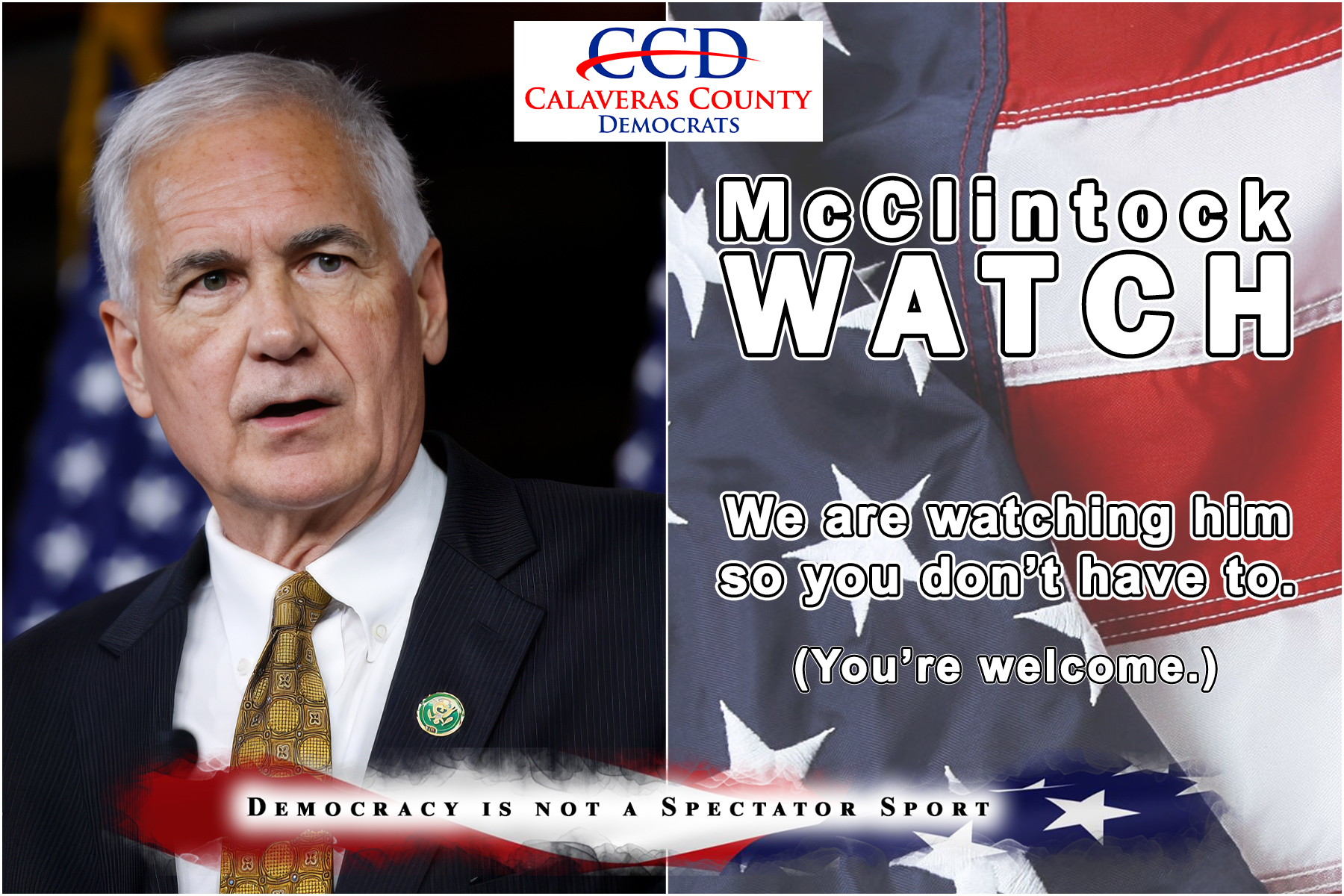
For the past 17 years, since first elected in 2009, our Representative Tom McClintock — a carpet bagger who has never even lived in our District (he moved to Elk Grove from Southern California to run in an open seat) — has cast votes that shape our healthcare access, our civil rights protections, environmental protections, our local economy, and the safety nets many of our neighbors rely on. Those votes are public. They are documented. And they matter.
That’s why we took the time to compile a list of specific votes that have weakened civil rights protections, shifted economic burdens onto working families, and prioritized party-line ideology over the practical needs of rural communities like ours.
This isn’t about campaign slogans or television ads. It’s about representation and accountability.
Do we want to keep electing representatives who consistently align with national party agendas — even when those agendas shift costs onto rural counties, strain local hospitals, go against overall public popular opinion and limit protections that affect everyday people?
Or do we want to be bold enough to demand leadership that puts Calaveras County and our neighboring rural communities first?
The votes are on the record. The impacts are real. And as we approach the midterms, the decision belongs to us. Let’s review 9 key votes that went against our best interests during the 17 years he’s benefited from district support.
-
Voted for Trump’s “Big Beautiful Bill” cutting Medicaid, SNAP, and social safety net programs
✔ McClintock voted in favor of the massive reconciliation bill that delayed painful cuts — including Medicaid (MediCAL) reductions, Veterans benefits, SNAP cost shifts to states, and work requirements — until after the mid-terms so voters wouldn’t connect the pain to the vote. This bill is projected to reduce Medicaid spending by nearly $1 trillion over the next decade and leave millions uninsured. This will hurt rural hospitals (like Mark Twain Medical Center) and vulnerable families in District 5. It’s kitchen-table economics that directly affects grocery bills, medical care, and senior support.
-
Support for broad immigration enforcement with potentially unconstitutional effects
✔ McClintock has repeatedly backed Harsh Immigration Enforcement measures, including advancing a provision* that civil rights advocates warn could let the government challenge or revoke citizenship even for U.S.-born citizens under flawed legal interpretations.
*This provision refers to Executive Order 14160, which sought to reinterpret birthright citizenship under the Fourteenth Amendment. The order directed federal agencies to withhold automatic citizenship recognition for certain U.S.-born children based on their parents’ immigration status, challenging the long-standing understanding that anyone born in the United States is a citizen.
He also previously voted against increasing H-2B work visas and against expanding family-based immigration limits, actions that go directly against crucial rural workforce needs that have been accepted for decades. Sure, let’s have immigration REFORM. First congress (collectively and collaboratively as the body it is) has to have the courage to take it on!
-
A Voting Pattern of Unequal Treatment
✔ McClintock was one of a small group of House Republicans who voted against establishing June 19th (Juneteenth) as a federal holiday.
Here’s why this vote is important: enslaved Black people in America in Texas were legally free on January 1, 1863; but many were not told and not liberated until Union troops enforced it on June 19, 1865. More than two years of stolen freedom and justice delayed. That’s what Juneteenth marks: not just emancipation, but the delay in justice.
What other community has he marginalized? The Violence Against Women Act of 2013 included important provisions that expanded protections for Native American women on tribal lands; particularly allowing tribal courts to prosecute certain non‑Native offenders who commit crimes against Native American victims on tribal reservations. Many tribal sovereignty advocates supported this; Tom McClintock voted no on the version of the bill that included these expanded tribal protections and was a key player in watering it down.
When a representative votes against recognizing black history (or Native American history) you have to ask — who else doesn’t really matter to Tom McClintock?
-
Opposed same-sex marriage protections
✔ He opposed the Respect for Marriage Act — a bill that codified protections for same-sex and interracial marriages at the federal level. If conservatism means you don’t want the federal government telling you who you can marry or what you can do in your own home, this vote falls in the category of eroding our civil liberties as there is widespread public support for these protections throughout the land. Just not in McClintock-land.
-
Opposed expanding legal immigration access
✔ McClintock voted against the Fairness for High-Skilled Immigrants Act (to remove per-country caps on employment visas) and against expanding H-2B work visas. It passed in 2020 but you could have had a much harder time finding the skilled workers rural economies rely on had it not passed. Why does he keep voting against our best interests?
-
Opposed mail-in voting and questioned 2020 election integrity
✔ McClintock publicly opposed mail-in voting and echoed critiques of election integrity that were part of the 2020 post-election debate (a debate that withered under the scrutiny of 60 court cases where judges, including judges appointed by President Trump and other Republican presidents, looked at the evidence in many cases and said there is not widespread fraud.
This is designed to undermine faith in our democratic process. With control of Congress at stake in the 2026 midterm elections, Trump is doubling down on efforts to end mail-in voting. What is McClintock’s current position? In the 2024 election, nearly 30% of Americans who voted cast their ballots by mail, including most Californians, where mail in voting is universal. Did you?
-
Voted to Expand Logging Without Environmental Review in National Forests
✔ Rep. Tom McClintock has repeatedly voted in favor of expanding “categorical exclusions” under the National Environmental Policy Act (NEPA), including provisions in federal spending and infrastructure bills that allow logging projects of significant acreage to move forward without full environmental review or public comment.
He argues this speeds up forest thinning, but it seems far more obvious as claimed by conservation groups and wildfire scientists that these broad exclusions really result in:
- Limited community input on projects in local forests
- Reduction of environmental safeguards protecting watersheds and wildlife
- Prioritization of commercial timber extraction over targeted fire mitigation; and
- Can open the door to large-diameter tree removal that does little to reduce wildfire risk
In the Sierra Foothills, where our economy depends on recreation, tourism, clean water, and responsible land stewardship, forest policy isn’t abstract. Decisions about Stanislaus and Eldorado National Forests directly affect:
- Water quality flowing into our communities
- Wildlife habitat
- Local fire behavior
- Outdoor recreation and tourism
A truly committed representative would support investing primarily in community fire hardening (a key insurance industry issue), defensible space, and home protection strategies that many fire experts say are more effective for rural towns. Ask yourself: who (or whom) is his vote truly benefiting in this case?
-
Voted YES on the SAVE Act — Making It Harder for Eligible Citizens to Vote
✔ McClintock voted in favor of the SAVE Act (Safeguard American Voter Eligibility Act), which would require Americans to provide documentary proof of citizenship — such as a passport or certified birth certificate — in person when registering to vote or updating their voter registration. (This bill passed the House and is currently under consideration in the Senate.)
This is yet another dangerous distraction and manipulation for voter suppression. Here’s why: what the SAVE Act would do in practice is make registration significantly harder for eligible voters — especially in rural counties like Calaveras.
Why is that?
- Many residents do not have a current passport (Is yours current? Know where it is?)
- Married women who changed their last name, or married partners who have combined their names, may not have a birth certificate that matches their legal name
- Seniors born at home may have delayed or hard-to-obtain birth records.
- Rural voters who rely on mail registration would be required to appear in person with documentation.
- Any address update could trigger new paperwork requirements.
In a county where people already drive long distances for services, adding more documentation hurdles means fewer people participating — not more “secure” elections.
Voting fraud is already illegal. The SAVE Act doesn’t fix a widespread problem. It creates new barriers for lawful voters.
Ask yourself: does making it harder for eligible citizens in Calaveras County to register and vote protect democracy — or restrict it?
-
Consistent high conservative ideological score
✔ McClintock’s lifetime score on the Heritage Action conservative scorecard is about 88%, signaling a consistent pattern of aligning with hardline ideological positions rather than moderate or bipartisan solutions. The Supreme Court just handed down a ruling on the Tarriff issue that included this quote:
“Yes, legislating can be hard and take time,” wrote Justice Gorsuch, a Trump appointee who is part of the court’s conservative majority. “And yes, it can be tempting to bypass Congress when some pressing problem arises.
But the deliberative nature of the legislative process was the whole point of its design. Through that process, the nation can tap the combined wisdom of the people’s elected representatives, not just that of one faction or man.”
Tom McClintock likes to make lengthy speeches on the house floor about what he thinks and get them covered in the local press, but we don’t pay him for that. His job is to represent us, the voters, to work collaboratively in congress to pass laws that support issues his constituents care about.
Here’s how these votes directly affect rural District 5
If you’ve forgotten how these votes have (and will) affect everyday lives, services, and dignity of ordinary people like you and me here’s a reminder (and don’t forget, the real pain does NOT kick in until AFTER the midterms – and that was purposeful):
- Healthcare Cuts (Medicaid) → Rural hospital strains; long travel for care; vulnerable seniors and children lose coverage.
- SNAP & Food Aid Changes → Grocery bills rise, families struggle for basic food access.
- Immigration Enforcement Bills → Fear and instability in communities with immigrant families; potential labor shortages in agriculture.
- Voting Rights Positioning → Undermines confidence and civic participation in rural areas.
- Resistance to Same-Sex Marriage Protections & Civil Rights Measures → Positions his office out of step with majority popular support.
It’s Not Personal
This isn’t about personality — it’s about a pattern of votes that, taken together, reflect priorities often at odds with the economic and social well-being of everyday rural Californians. McClintock consistently chooses ideology over community needs, and understanding this pattern matters as we head into elections.