


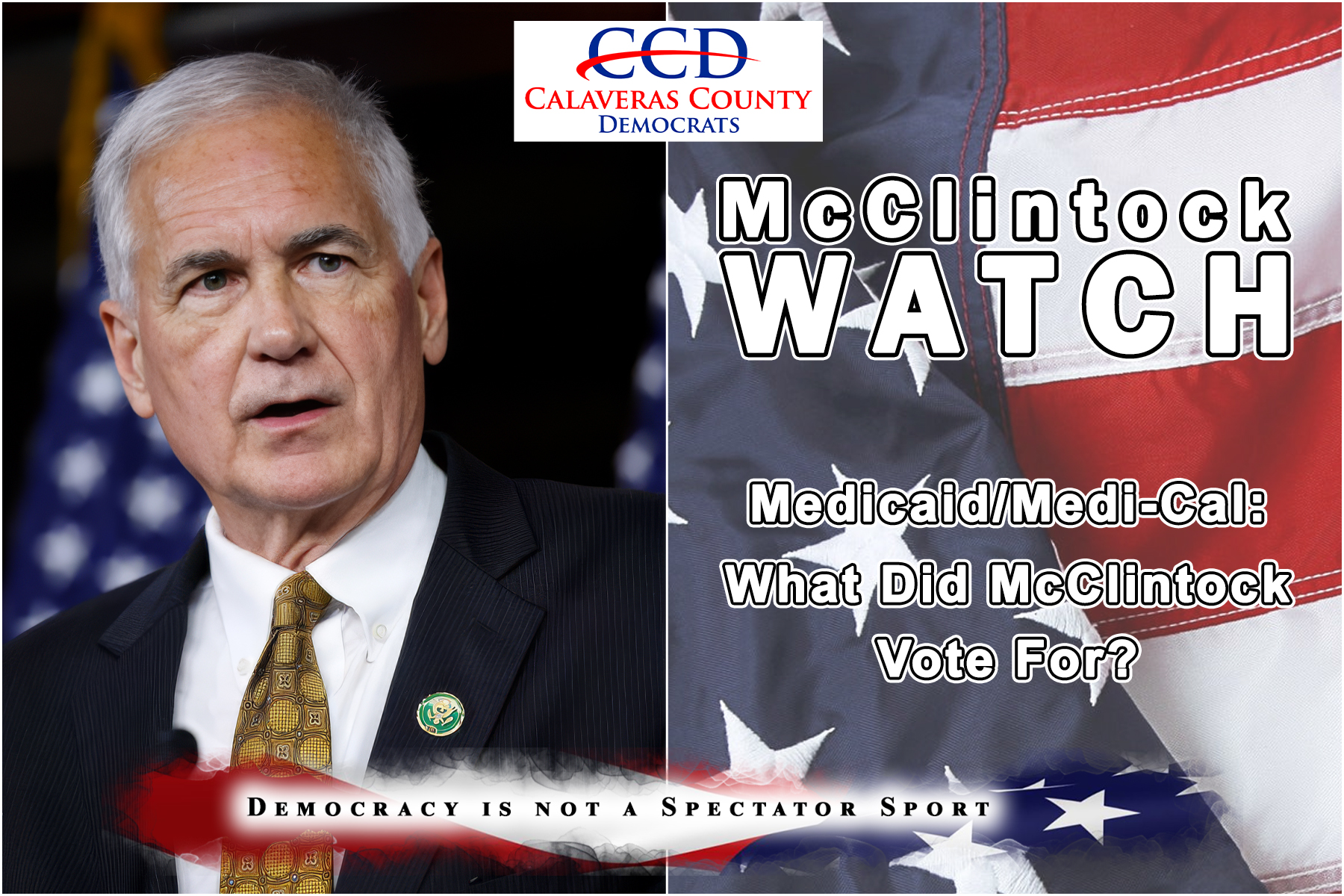
Medicaid/Medi-Cal: What Did McClintock Vote For?
For many people, Medicaid sounds like a program that belongs somewhere else. In California, we call it Medi-Cal.
Who does it help? Children make up a large share of enrollees, covering nearly half of all children in low-income families and children with special health care needs. It covers low-Income adults and parents including parents and caretaker relatives, as well low-income seniors aged 65 and older, often supplementing Medicare for those who are dually eligible. Finally, Medi-Cal covers millions of individuals living with physical, intellectual, or developmental disabilities.
For some families in rural California, Medi-Cal is the difference between getting medical care and going without it.
Tom McClintock voted for H.R. 1 in 2025 (aka the Big Beautiful Bill). The bill made major changes to Medicaid, including new eligibility and enrollment requirements.
The Congressional Budget Office estimated that the House version of the bill would result in millions more Americans being uninsured by 2034 compared with current law.
That doesn’t mean every person in Calaveras County on Medi-Cal will lose coverage.
But it does mean the rules changed. And rules matter. What does it say about a government that cuts services and imposes work requirements on the most vulnerable among us?
- According to an analysis by the California Budget & Policy Center, H.R.1 enacts roughly $1 trillion in federal cuts to Medicaid
- Researchers at the California Health Care Foundation estimate that the bill’s new strict work-reporting requirements could cause 1.1 million Californians to lose their Medi-Cal coverage by 2029–30 due to “administrative and reporting barriers” – that means the complex paperwork you will need to complete…and of course, if you can’t find a job you’re out of luck, and you’re out of healthcare too.
- Perhaps an unintended consequence, but a real risk especially in rural areas like Calaveras County is that when losing Medi-Cal revenue, local hospitals and healthcare facilities will feel the strain, potentially forcing downscaling or closures that affect all residents regardless of insurance status. Perhaps McClintock didn’t consider this when voting. Or, maybe he did and just didn’t care.
- The Accountability Scorecard notes that at the time of the vote, the Congressional Budget Office (CBO) estimated the legislation would trigger billions in Medicare cuts over the next decade. Approximately 22.9% of the population in Calaveras County is covered by Medicare, according to Data USA health coverage statistics.
Supporters of the legislation, including Representative McClintock and congressional Republicans, argue that the reforms are necessary to improve “fiscal responsibility” and “free market competition.” The use of those two grossly misused conservative terms flies directly in the face of the actual actions taken by this administration. Increasing the deficit by a trillion dollars so rich people can get richer is not a “conservative” value, it’s just plain wrong and unfair. There’s nothing wrong with making a profit, that’s what capitalism is all about – but can we please level the playing field so everyone can benefit???
As we all know first-hand, in a rural county, getting health care can already mean traveling a long way. We have fewer doctors and fewer specialists than large cities.
When someone loses health coverage, the problem doesn’t necessarily disappear. Sometimes the person simply waits.
Then a small medical problem becomes a bigger one.
That can be harder on the family, harder on the patient and harder on the health-care system. The important question isn’t whether we like or dislike a particular political party. The question is simple:
Did this vote make it easier or harder for people in our community to get the health care we need?
That’s a question worth asking every member of Congress.