


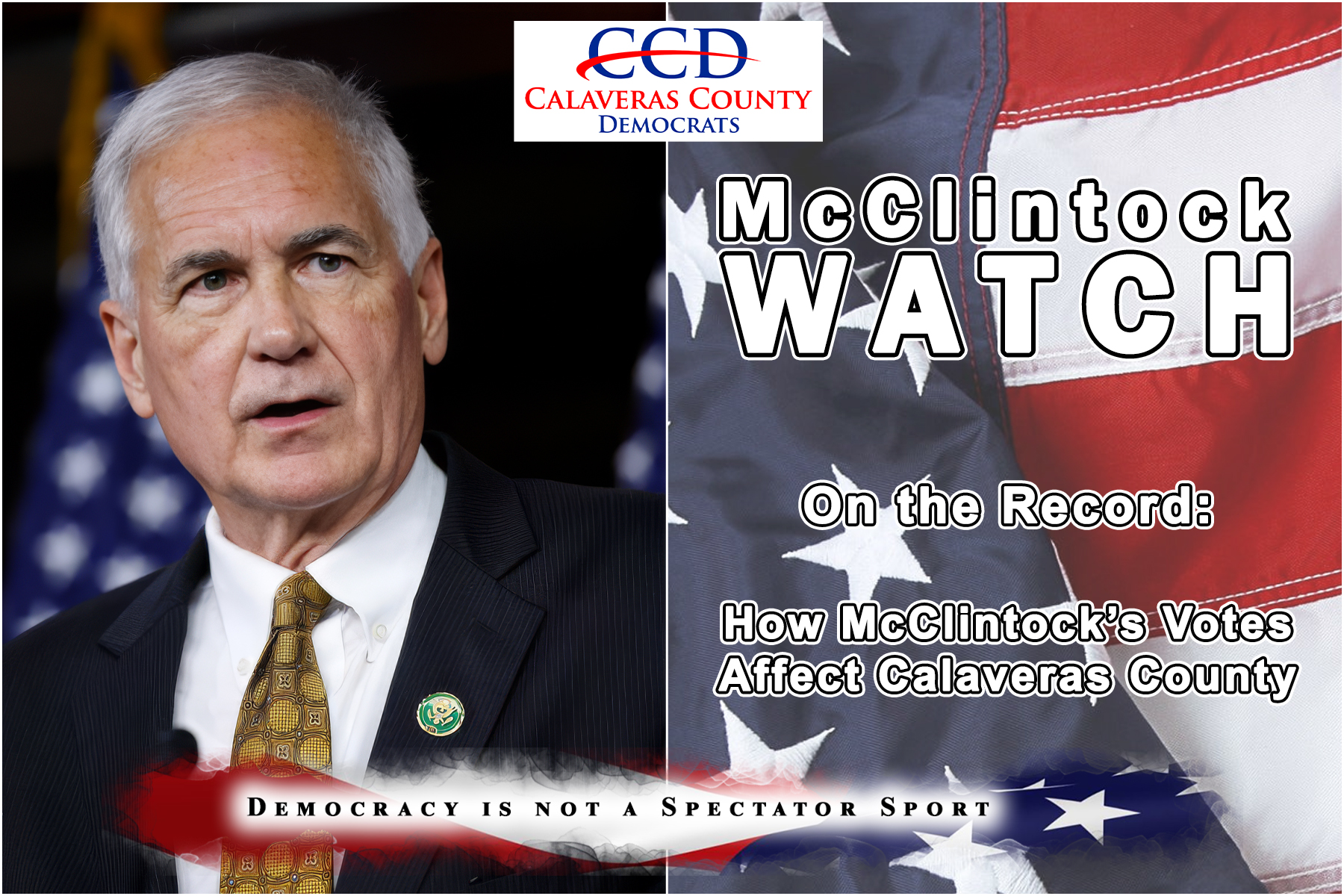
On the Record: How McClintock’s Votes in 5 specific areas Affect Calaveras County
For months, our On the Record and McClintock Watch series have examined how Congressman Tom McClintock’s votes in Washington affect people here at home.
As we look toward next week’s mid-term elections, this final installment connects those votes to the issues that matter in Calaveras County: access to healthcare, putting food on the table, local jobs, equal treatment under the law, voting access and the future of our public lands.
These are not abstract policy debates. They are decisions with consequences for our families, neighbors and community.
- Healthcare: A vote that puts rural hospitals under greater pressure
McClintock voted for H.R. 1, President Trump’s 2025 budget reconciliation law, which was signed on July 4, 2025. The law makes major cuts to federal Medicaid spending and changes who qualifies for coverage and how states finance the program. The Congressional Budget Office estimated that its health provisions would leave 10 million more people uninsured nationwide by 2034 than under its baseline projections.
What does that mean here?
- Patients may lose Medi-Cal coverage. New work-reporting requirements and more frequent eligibility reviews mean some people will lose coverage, including people who qualify but struggle to complete the required paperwork.
- Hospitals face lower revenue and more unpaid bills. When patients lose insurance, they may delay care until they are sicker, while hospitals still have to treat emergencies.
- Mark Twain Medical Center has a direct stake in these changes. At a January 2026 California Assembly hearing, a representative of Dignity Health Mark Twain Medical Center said the hospital relies on the Medi-Cal provider fee to remain viable. That makes federal changes to Medicaid funding a serious concern for our local hospital.
No one can say from the vote alone that Mark Twain will close. But the financial pressure is real: reducing Medicaid funding and coverage threatens the resources rural hospitals need to keep services available.
The timing matters, too. Some of H.R. 1’s major Medicaid requirements are scheduled to take effect in 2027. Whether Republican lawmakers chose a post-mid-term election timeframe specifically to influence voters is a separate question. What is clear is that McClintock voted for the law, and its effects will continue unfolding after the November 2026 midterms.
- Forests and public lands: Faster management, with tradeoffs to consider
McClintock supported legislation to expand the use of categorical exclusions under the National Environmental Policy Act for certain forest-management activities, including logging-related work. This reduces the level of environmental review required. Who benefits most here?
For Calaveras County, forest-management decisions can affect wildfire preparation, watersheds, wildlife habitat, recreation and nearby communities. The relevant question is not just whether a project moves faster, but what work is done, where it occurs and how its results are monitored.
- Food assistance: SNAP changes reach household grocery budgets
The same law McClintock supported changes the Supplemental Nutrition Assistance Program (SNAP), commonly known as food stamps. The Congressional Research Service says the law is expected to reduce federal SNAP spending by nearly $187 billion over ten years.
The changes include stricter eligibility requirements for some recipients, limits affecting benefit calculations and new state cost-sharing responsibilities. Some households will face reduced benefits or may lose eligibility; the impact depends on their circumstances and how the provisions are implemented.
For rural families, older adults, people with disabilities and working households struggling with high grocery bills, SNAP can help keep food on the table. Shifting costs to states can also put pressure on state budgets and the agencies responsible for administering the program. Residents tapping Calaveras County food bank have tripled over the past two years.
The connection is direct: McClintock voted for the law that enacted these changes. The consequences will not be the same for every household, but reduced federal support and tighter eligibility rules mean some people will have less help buying groceries.
- Civil rights: His votes reflect specific positions on equal treatment
McClintock opposed the Respect for Marriage Act, which Congress passed in 2022 to provide federal protections for recognition of valid marriages, including same-sex marriages. He also voted against a version of the Violence Against Women Act that included provisions expanding tribal courts’ authority over certain crimes involving non-Native defendants.
He opposed making Juneteenth a federal holiday as well.
These votes involved different questions: federal recognition of marriages, tribal sovereignty and responses to domestic and sexual violence, and national recognition of the end of slavery in the United States. Taken together, they provide a record of his positions on these issues—not simply a summary of what he says about limited government or individual rights.
- Voting access: The SAVE Act and proof of citizenship
McClintock supported the SAVE Act, legislation that would require documentary proof of U.S. citizenship to register to vote in federal elections. Guess what? Noncitizens are already prohibited by federal law from voting in federal elections. And numerous court challenges have debunked claims of voter fraud every time one is brought. So, why more legislation?
This matters in rural communities, where travel, access to government offices and the time needed to resolve paperwork problems can create additional burdens. If the intent is to try to make it harder for progressives to vote, the result will be to make it harder for EVERYONE to vote.
What this voting record tells us
We have examined the record—not just the rhetoric. The goal of this series has been to connect votes and decisions our representative in Washington make to the everyday realities of people who live here (the people who he reports to and for whom he is supposed to be working).. Healthcare, food costs, jobs, civil rights, voting rules and public lands are not distant political abstractions. They shape the future of our rural communities.
If you have not yet seen the debate on KCRA between Michael Masuda and Tom McClintock you can watch it here. Then go vote! The election is November 3!